If you own a home in Los Angeles and you’re thinking about a reroof, you’ve probably heard the phrase “cool roof” thrown around by contractors, utility reps, and the state of California itself. Most articles about cool roofing read like marketing brochures — all benefits, no specifics. This one is different. I’m a licensed roofer who has installed cool roofs on homes from the Venice coastline to the inland San Fernando Valley. Here is what actually matters about cool roofing in LA, what the law says, and what it costs.
What a “cool roof” actually is (and isn’t)
A cool roof is any roof with materials rated to reflect more sunlight and release more absorbed heat than a standard roof. It is not a single product or a single color. Cool versions of asphalt shingles, concrete tiles, clay tiles, metal, TPO, PVC, and coatings all exist. The thing they have in common is a listing on the Cool Roof Rating Council directory (coolroofs.org), which publishes two numbers for every rated product:
- Solar Reflectance (SR) — how much of the sun’s energy the surface bounces back rather than absorbing. Scale of 0 to 1. Higher is better.
- Thermal Emittance (TE) — how readily the surface releases any heat it did absorb. Also 0 to 1. Higher is better.
Those two numbers combine into a third, the Solar Reflectance Index (SRI). California code and most utility rebates reference either the SR/TE pair or the SRI — and, importantly, they only count products that appear on the CRRC directory. If a contractor tells you a product is “cool-rated” but can’t give you a CRRC product ID, it doesn’t qualify.
Why LA’s specific climate makes cool roofing a better fit here than almost anywhere
Los Angeles County spans five of California’s 16 Title 24 climate zones:
- Zone 6 — coastal strip (Santa Monica, Venice, parts of the Westside)
- Zone 8 — central LA basin (most of the city proper)
- Zone 9 — inland valleys (San Fernando Valley, San Gabriel Valley, most of the Pasadena/Glendale belt)
- Zone 14 — high desert (Santa Clarita north, Lancaster, Palmdale)
- Zone 16 — mountains (Big Bear, parts of Angeles National Forest edges)
Inland zones 9 and 14 are where cool roofs earn their keep the fastest. A black asphalt shingle roof in Woodland Hills or Pasadena routinely hits surface temperatures of 160–180 °F on a July afternoon. The attic below it can push 130–140 °F. A cool-rated roof on the same house typically runs 40–60 °F cooler at the surface and drops attic temperatures by 15–25 °F. That difference is what translates to a quieter, cheaper AC.
LA also has the urban heat island problem to deal with. Paved, dense neighborhoods run several degrees warmer than outlying areas because dark surfaces absorb and re-radiate heat. Cool roofs are one of the only fixes a single homeowner can make that measurably cools their own property — and, scaled across a neighborhood, cools the street.
California Title 24: when a cool roof is required vs. when it’s just recommended
Title 24, Part 6 is California’s Building Energy Efficiency Standards. The 2022 version is in force as of January 2023 and governs new construction and most reroofs. The short version for LA homeowners:
- Low-slope roofs (flat or near-flat) on existing homes: a cool-rated product is required under the prescriptive compliance path in most LA climate zones when you’re replacing more than 50% of the roof area. This includes the flat sections over attached patios, room additions, and many mid-century homes in the basin.
- Steep-slope roofs (the tilted kind most homes have): a cool roof is not always prescriptively required in coastal zones 6 and 8, but it is almost always the easiest performance-compliance path. In zones 9, 14, and 16 it’s the standard spec. If your roofer is pulling a permit with LADBS, they’ll run a Title 24 compliance calculation — a cool-rated product is usually how that math works out.
- Repairs under the 50% threshold: Title 24 cool-roof rules don’t trigger. You can patch a small section with whatever matches.
The practical upshot: if you are reroofing more than half your roof in Los Angeles County, you should plan on a cool-rated material. Not because someone is forcing you to, but because it’s the path of least resistance to a permit approval.
LADWP cool roof rebates (and what else might be available)
LADWP has run a Cool Roof Rebate for residential customers for several years. The program pays per square foot of qualifying cool roof installed on an existing home — historically in the ballpark of $0.20–$0.30 per sq ft for single-family homes, with product eligibility tied to CRRC listing and minimum SR/SRI thresholds. Rebate amounts, caps, and eligibility rules change periodically, so verify the current program at
ladwp.com/coolroofs before quoting a number to a customer.
Other programs worth checking before your install:
- SoCalGas and SCE occasionally offer energy-efficiency rebates that stack with a cool roof install, especially when paired with attic insulation upgrades.
- The federal Energy Efficient Home Improvement Credit (IRS Section 25C) can cover up to 30% of qualifying improvements, capped annually. Cool roofing alone isn’t specifically called out, but paired with qualifying insulation work it may apply — consult a tax professional.
- Some LA homeowners qualify for PACE financing (HERO, Ygrene successors) that amortize the cool roof cost onto property taxes.
What a cool roof actually feels like in your house
Three things change noticeably:
- Your AC runs less. Most of our Pasadena and Encino customers report cycle-time reductions of 20–35% in peak summer after a cool-rated reroof paired with adequate attic ventilation. Actual savings depend on your existing insulation, duct location, and AC age.
- Your upstairs rooms stop being unusable. In two-story LA homes with vaulted ceilings, the upstairs is often 8–12 °F hotter than the downstairs in August. A cool roof typically cuts that differential in half.
- Your utility bills drop. A realistic range for a 2,000 sq ft single-family home in an inland LA zone is $200–$600 in annual AC savings — not the “$2,000 a year” you’ll sometimes see advertised. Pair the roof with attic insulation and you get closer to the high end.
What actually drives the cost of a cool roof in LA
Cool-roof pricing varies more than most homeowners expect, and any contractor who gives you a firm number before walking your roof is guessing. Your project’s cost comes down to a handful of specific factors:
- Material choice. Cool-rated architectural asphalt shingles sit at the entry level. Cool-rated single-ply membranes like TPO and PVC for low-slope roofs fall in the middle. Cool-rated concrete and clay tile run higher. Cool-rated standing-seam metal is typically the most expensive up front, with a service life to match.
- Coating vs. full reroof. An elastomeric cool coating over a sound low-slope roof costs a fraction of a full tear-off and replacement. But it’s only an option if the underlying membrane is in good structural shape with no active leaks — coatings are maintenance, not replacement, and they don’t fix a failing substrate.
- Tear-off layers. One layer of existing shingles costs less to remove than two or three. California code typically requires full tear-off at a reroof anyway, but the labor and disposal scale with what’s up there.
- Roof size, pitch, and access. Steeper roofs and homes with tight side-yard access take longer to work on safely. Two-story hillside homes cost more per square than single-story homes on a flat lot.
- Hidden damage. Decking replacement, rafter repair, dry rot around skylights or chimneys — none of it is visible until the old roof comes off. A good estimate will spell out the unit rate for these items so you’re not surprised by a change order.
- Ventilation and Title 24 compliance. A reroof is the natural moment to bring attic intake/exhaust airflow into spec and document Title 24 compliance. These aren’t large line items, but they move the final number and they matter at resale.
- Rebates. LADWP (or Burbank Water and Power for Burbank homeowners) cool-roof rebates, manufacturer promotions, and the occasional stackable utility incentive can offset a meaningful portion of the project cost. We’ll tell you on the first visit which programs your home qualifies for.
For a real number on your specific home, the only honest answer is an on-site estimate. We’ll walk the roof, pull measurements, check the attic and ventilation, and send you a written scope with a firm price on it — free of charge and no pressure. Call us today for a free estimate.
A real Ikon job: a Magnolia Park cool-roof reroof
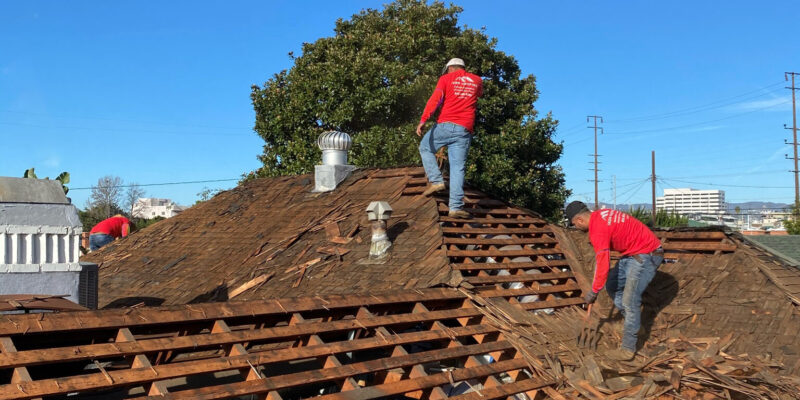
Earlier this year we reroofed an 1,850 sq ft single-story ranch home in Burbank’s Magnolia Park neighborhood. The homeowners had lived in the house since 2008, and the original 3-tab asphalt shingles were well past their service life — visible granule loss, curling at the edges, and a living-room ceiling that hit 82 °F every afternoon in August with the AC running nearly nonstop.
We pulled a Burbank Building and Safety permit, tore off the old shingles and a layer of 30-year-old underlayment, replaced two sections of sheathing that had minor dry rot, and installed Owens Corning cool-rated architectural shingles in a Forest Brown color that fit the block. We also upgraded the attic ventilation — the original box vents weren’t close to meeting modern intake/exhaust ratios for a roof of that size.
Before the reroof, we logged an attic temperature peak of 138 °F on a 96 °F day in late July. Three weeks after the install, on a comparable 94 °F day, the attic peaked at 109 °F — a 29-degree drop. The homeowner’s September Burbank Water and Power bill came in 31% lower than the same month the prior year, and they qualified for BWP’s residential cool-roof rebate, which offset roughly $0.20 per square foot of the upgrade cost over a standard shingle. Their note to us read, in part: “The upstairs bedroom is finally usable in the afternoon. We should have done this five years ago.”
Frequently asked questions
Does a cool roof have to be white?
No. White and light colors reflect best, but there are now cool-rated shingles and tiles in a wide range of colors — including dark browns, grays, and terracotta — that use specialized pigments to reflect infrared light while looking conventional. If you live in an HOA that requires a specific shingle color or a historic-overlay district that requires a specific tile look, there is almost certainly a cool-rated version that complies.
Will a cool roof last longer than a standard roof?
Usually yes, modestly. Lower peak surface temperatures mean less thermal cycling, which means slower adhesive breakdown, less shingle cracking, and less tile expansion stress. Expect 10–20% longer real-world service life from the same underlying material in a cool-rated color vs. a dark color.
Does it still work on a north-facing or heavily shaded roof?
The benefit is smaller but still real. Most LA roofs get significant sun on multiple planes over the course of the day, and Title 24 compliance is based on the whole-roof assembly — so using cool products on the shaded north slope doesn’t penalize you.
Can I skip the reroof and just add a cool roof coating?
Only on a low-slope roof (typically less than 2:12 pitch) that is structurally sound with no active leaks. Coatings are maintenance, not replacement — they don’t fix a failing substrate. Most sloped shingle and tile roofs in LA are not candidates for coatings.
Will Title 24 force me to replace the whole roof when I only wanted a patch?
No. Title 24’s cool-roof requirements kick in when you cross the 50% replacement threshold. Under that, patch away with matching material.
Ready to talk about a cool roof for your LA home?
Ikon Roofing is a C-39 licensed contractor serving Los Angeles and the surrounding valleys. We pull LADBS permits on every reroof, run Title 24 compliance calculations as part of the estimate, and help homeowners apply for LADWP rebates where they qualify. If you’d like a free on-site assessment — including a look at your current attic temperatures and ventilation — we’re happy to come out. Call us today for a free estimate.